Laura Berman
Contact: lberman [at] wisc [dot] edu
Laura has worked in association with the Great Basin Bird Observatory, the United States Geological Survey, the Smithsonian Conservation Biology Institute, the Smithsonian Tropical Research Institute and the University of Maryland, College Park. She completed her BS at Juniata College and her PhD at the National University of Singapore.
Her research interests include long-term visual and acoustic ecosystem monitoring, development of machine learning methods for automatic species identification, the impact of climate and habitat on population phenology, and human-wildlife cooperatively beneficial landscape use.
She currently works with Snapshot Wisconsin and the NASA Jet Propulsion Lab assessing patterns of mammalian and avian biodiversity dynamics across time and space.
In her free time, Laura enjoys rock climbing, kayaking, bird watching, and general mischief.
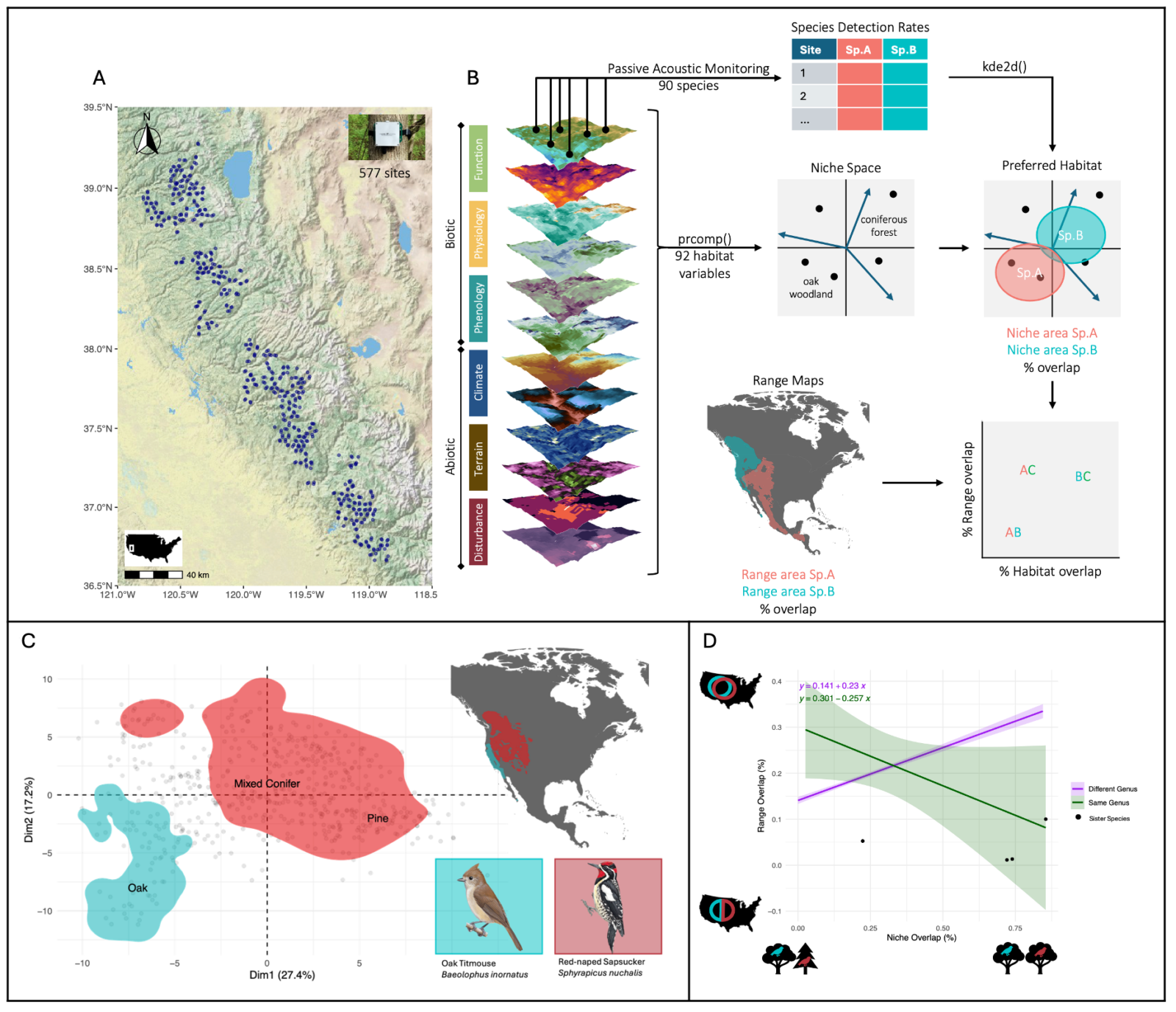
Methods and results for quantifying niche preference, specificity, and overlap among birds in the Sierra Nevada using bioacoustics and geospatial data. A) Map of the 577 bioacoustic sampling sites. B) Workflow. Passive acoustic monitoring and machine learning species classification were used to measure the relative abundance of 90 bird species across 577 sites. PCA was run using 92 geospatial habitat variables to describe available niche space, and kernel density estimates were used to describe each species use of that niche space. For each species pair, patterns of niche overlap were compared with overlaps in known breeding range. C) Example of niche overlap and breeding range overlap of one species pair. D) Overall pattern of niche/range overlap among the 4,009 species pairs. Heretogeneric species generally showed a positive correlation between niche overlap and range overlap, consistent with the theory of habitat filtering. Congeneric species generally showed a negative correlation, consistent with the theory of niche partitioning.